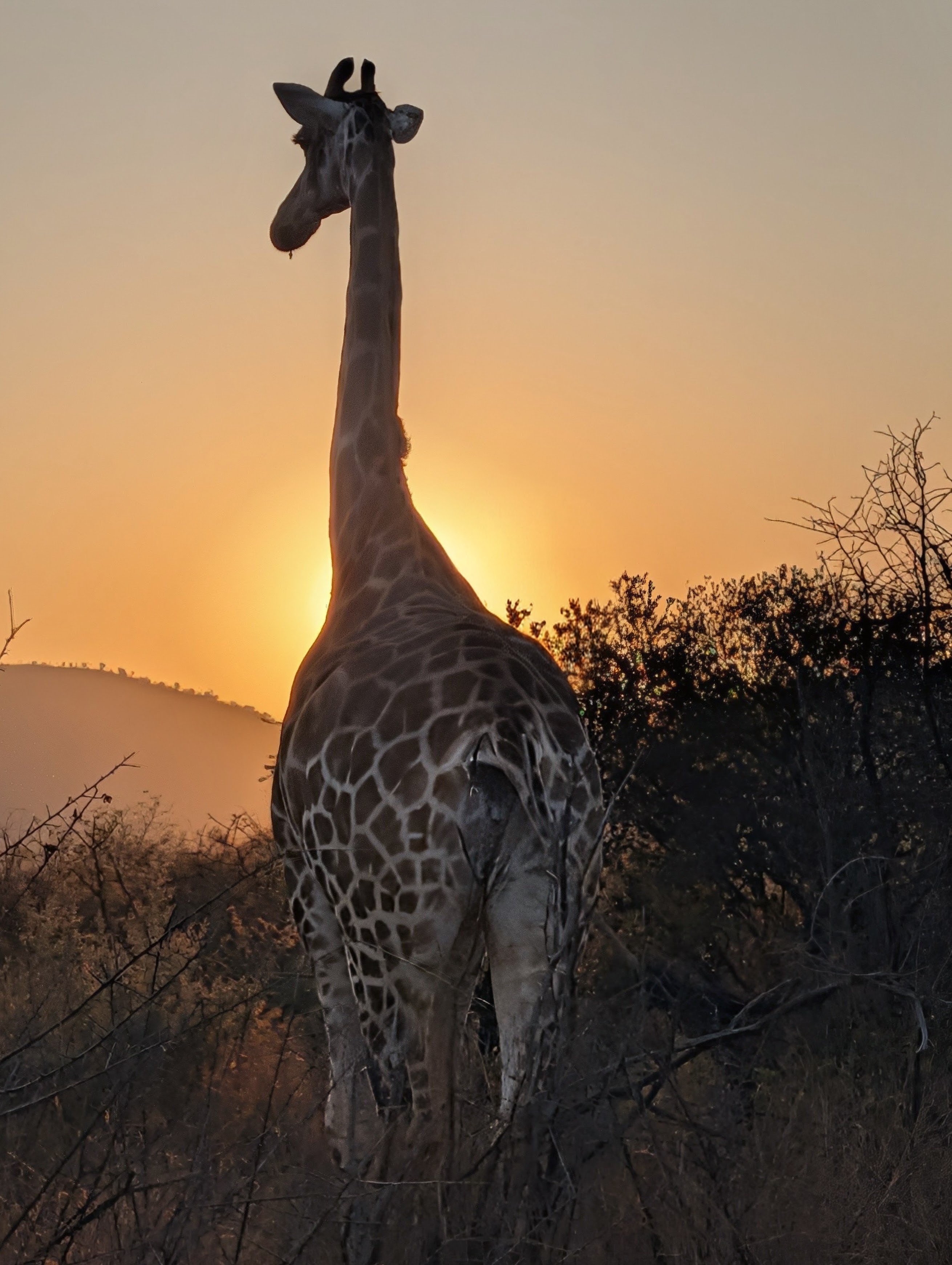
A couple of weeks ago, we spent another week in Pilanesberg Game Park. This, therefore, is another post about my favorite topic: Game Animals.
People sometimes ask us why we want to keep going to game parks; isn’t seeing a few elephants, giraffes, zebras, lions etc. enough? Our answer is a loud, resounding “No!” They question why we keep taking photos when we already have hundreds of photos of (elephants/giraffes/fill-in-the-blank). To me, that’s like asking someone why they’re taking photos of their friend when they already have hundreds of photos of random people. We take photos of people/animals/things that bring us joy, and there is no doubt that interacting with, and photographing, wild animals in their natural environments brings us great joy.
I use the word interacting intentionally. No, we don’t get out of the truck or try to stroke the animals as they walk past. We turn off the truck’s engine and observe quietly, sometimes for hours. We stay long enough that the animals accept us as part of the scenery (which is probably why we have so many close shots of animals). That time spent with the animals makes a difference and is probably why each photo of an animal is important to us. For example, to us it’s not just another elephant, but the elephant that was grumpy/silly/chased a butterfly/farted louder than any other elephant we’d observed. And so on. If a safari is a once-in-a-lifetime event for a person, there’s no time to observe; you find a lion, take a photograph of a lion, then move on to find the next animal. We are spoiled; we know it and we greatly appreciate it. We spend 10 hours a day in a game park and we self-drive, so when we come across something interesting we sit and observe for as long as the animals are there.
Thus, this time I’m going to write about a handful of the life stories we were able to be a part of briefly. Of course, I’ll intersperse these with a few of my favorite photographs…starting with our first cheetah ever!


Story #1 Whilst driving around one day, we saw what we thought to be three rhinos so we stopped to watch them.

As they got closer, we were thrilled to note that there were five of them; four adult females and a baby/toddler. To our delight, they eventually wandered out of the tall grass so that we could get a clear view of them.

At times, one or another would wander very close to the truck whilst grazing so we truly thought that the sighting couldn’t get any better…


BUT THEN we watched as a male rhino came jogging down a hill, clearly with a purpose in mind. Rhinos have a top speed of 25-40mph (30-55km/h) but, although this one was moving quickly it was at a less scary pace! The crash of five rhinos gathered into a tight group and, as the male approached, they grunted and snorted whilst swaying their heads until the male moved away to ‘graze’.

Within the circle formed by the original crash, the mother and baby rhinos immediately lay down; we noticed, however, that they weren’t resting per se as their eyes didn’t leave the male. The male kept ‘grazing’ but edged closer and closer to the crash. As he neared the group, one of the females walked right up to him, stood in front of him, and the two seemed to have a staring contest. After a while, she returned to the circle and immediately lay down. One of the other two left standing walked up to her and, after some message was quietly conveyed, she too lay down.
This left only one female standing. The male approached her but was chased away. So the ‘grazing’ continued and, once again, he edged closer and closer to the group until he and the lone standing female were face to face. The two stood in that position for about five minutes but the female was unbending in her will…until the male pulled out his ace-card; he turned his bottom to the female. After looking at the bottom for a while (?? at least that’s what seemed to have happened), this last female standout lay down! Immediately, the male seemed to take on the part of sentinel to the crash.

It was fascinating to see and, to us, an excellent use of two hours. We found out through later research that one of the females (the last one standing) must have been ovulating and had been leaving signs of her desire for a male in her urine. Apparently, the males smell and taste the urine to determine if this is a female he’s interested in. All I can say is thank goodness I’m not a male rhino…or a female one, come to that! Males usually live alone but will join a crash of females for about 20 days to do his part in keeping the species alive. From what I read, the female may have accepted him as a suitor…but she’s going to give him a hard time over the next 20 days; feminism plays no role in animal behavior in the wild, but………you go, girl!!!
Before moving to the next story, I have to question how I’ve got this far without posting a photo of some elephants! I got so many great photos of elephants this time round but will only post four five seven…and two extras because we were at a picnic site when we had that face-to-face, no car experience…


Story #2 We were driving along a small, quiet dirt path up a hill one day when we looked down into the valley and saw four, seemingly very young, elephants moving quickly along the valley. This sparked our curiosities as we knew enough to know that this was unusual. We looked at the trajectory of the elephants path and drove to where we thought they’d emerge from the valley. After about 10 minutes, however, we realized that the elephants had either stopped along the way to eat (unlikely as they were beelining away from (or toward) something). Thus, we decided to retrace our path to try to find this odd little group.
And boy, we were fortunate to find them right alongside the dirt road.

But something was amiss; the little group was agitated and nervous of our truck. Nowadays, most of the time if all else is equal, wild animals aren’t stressed by cars as they know that nothing untoward will happen. The very young mother, baby, and two adolescents which comprised this group, were different; they were stressed and nervous. As we quietly followed the little group it became clear that they really wanted to go to a waterhole that was a couple of hundred meters away.

After staring at the waterhole for quite some time, they decided to make a dash for it (as did we…we drove along the road until we found a really good spot to observe this little group). The stress was still clear as, whilst two or three elephants drank, the other(s) stood guard.


We don’t know why these elephants were behaving so abnormally but, after having their fill of water, they wandered to an area where there were hippo wallowing in the mud and the older elephant tried to scare them (the hippos didn’t bat an eyelid and didn’t move).

Then, for some reason, the young mom turned on the two adolescents and chased them away…


After a while, the mom calmed down and the group reunited to reapply sunscreen.


Then, after gathering together near the hippo (who now, apparently, were no threat), with no audible communication, the four simultaneously turned on their heels and walked away.


As we were about to leave our spot (after about 1 1/2 hours), two bull-elephants entered the scene so we stayed a while longer. What was interesting in this encounter was watching one of the bulls taking umbrage with the hippos (the ones that had totally ignored the last little group) and mock-charging them; I’ve never seen hippos move so fast! All three hippos scrambled and splashed backward into deeper water so as to give the elephant plenty of room. There was certainly a different respect for the bull than there was for the cow and youngsters!

I learned later that there are a few reasons why a small group of elephants may be wandering alone. They may break into small groups:
- when food and/or water is scarce (not the case here);
- when the matriarch dies (though, most often, one of her daughters steps up to the plate to become the matriarch);
- when the herd has suffered a traumatic experience (hopefully not the case here);
- when a group becomes estranged from the herd for a short period of time because they wandered off.
I hope the latter is true for this little group of elephants as I don’t fancy their chances of survival otherwise as their ‘leader’ seems to have some real mental illness! I asked my friend if elephants suffer from mental distress and Google replied that they can experience deep psychological trauma and behavioral disorders that closely mirror human mental illnesses like Post-Traumatic Stress Disorder and depression. This is often caused by seeing family members killed (poaching and culling), by captivity and isolation, and by abuse. If only I were younger, I think I’ll be using my psychology degrees to determine if elephants suffer from mental illnesses similar to Bipolar Disorder as the young mother from this story was certainly behaving irrationally, unpredictably, and unconventionally. For the sake of the baby and adolescents, I hope that the little group of four caught up with their herd quickly!
We had so many wonderful sightings during this particular trip to Pilanesberg that it’s difficult to choose what photos to share before the next story; so here’s a mish-mash.


This was supposed to be a short post; I’ve failed!
Story #3 We happened across a hippo carcass one day (which was exciting in itself); sadly, as we approached, a lion walked away from it and went up a hill and out of sight.


We decided to stay with the carcass…just in case; and, sure enough, the lion soon ambled down from the hill.


We were watching some birds of prey swooping down for their turn with the carcass when…


This encounter took about 1 1/2 hours. Later, I learned that once a lioness is pregnant, she stops showing hormonal signs of being in heat and the lion becomes disinterested in the lioness and the pregnancy. I could comment from a human perspective…but better to leave you to draw your own conclusions. It was interesting to see how, after being intensely together for days, neither lion had any interest in the other; nature is fascinating!
I was reading yesterday about a lady organizing a round-the-world trip for her husband’s 50th birthday. Then, when the husband told her that going on a safari was also on his bucket-list, she added a 2 night, 3 day safari (in Kruger) to the trip. Her comment was that the first day on safari was great; they got photos of elephants, lions, zebras, giraffes etc. She also said that having a braai out in the wild before going to their air-conditioned tent to sleep was a wonderful experience. However, she advised people who wanted to go on safari that one day was enough as days 2 and 3 were just repeats of day 1! I suspect she and I wouldn’t have much in common; Dan and I don’t want to ‘see’ a lion, elephant etc. Instead, we want to experience them and for that, you need time. A lot of time.
Thankfully, retiring to S. Africa has given us both the opportunity and time. We have no idea how long it’ll be before we’ve reached our limit with spending time with wildlife; until then, we’re going to enjoy every moment of this wild and exciting ride.


Leave a Reply