
(Dan’s comments are bolded and italicized)
Before going to Kruger National Park, I’d like to take a moment to acknowledge the day. Not only is today (June 16) an incredibly sad day for Dan and myself (the anniversary of Rachael’s body being found), but also it’s a sad day in S. African history.
On this day in 1976, black school children from various townships gathered in Soweto to stage a peaceful protest against the Apartheid government’s Bantu Education Act of 1953. The name ‘Bantu’ is, in itself, highly derogatory, and the act enforced that black children would receive definitively inferior education which had to be delivered in Afrikaans (denying the use of their own languages and English). [Sidenote…I remember receiving corporal punishment in Wales in the mid 1960s for speaking Welsh to my brother on the school playground…my home language in my home country!]
An estimated 10-20,000 high-school students participated in this initial peaceful protest which led the Apartheid government to send in police dogs before shooting live ammunition into the throng of children. I clearly remember this being all over the news in Wales, where I lived at the time, and will never forget the photo that was on every news channel…
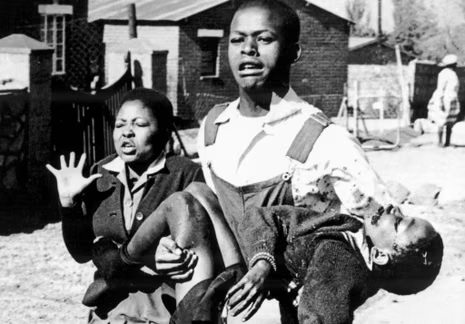
This is a photo of 13-year old Hector Pieterson, who was fatally shot, being carried by 18-year old Mbuyisa Makhubo, a fellow student, whilst 17-year old Antoinette Sithole, Hector’s sister, ran beside them. The official report states that 23 were killed on this day (if you believe that, I have a bridge to sell you) but the number of children and young adults that died during the resulting protests is probably closer to 700.
When Dan and I visited Soweto two years ago, we arrived at the memorial just as Antoinette Sithole was leaving; as of today, she’s 67 years old, still lives in Soweto, and visits the memorial site daily. One of my goals is to meet her one day…
…but, for now, Kruger! Last year we splurged and stayed in tented tourist accommodation across the river from the park (top notch for us!). This year, we decided to stay in Komatipoort town, about 8 km away. The tourist experience of staying in prime real-estate and having all your meals catered is great. But staying in a self-catering unit in town is a truer representation of Africa. Although they are so close to one of the most visited and exciting places in the world (I’m biased), most locals haven’t been into the park. Theirs is a subsistence lifestyle, and that they live so close to amazing animals has absolutely no bearing on their lives. It makes one wonder; westerners fly thousands of miles to see these fantastic animals whilst those who live 8 km away can’t afford it…!
The good thing about living in Kamatipoort is that, in a country where the unemployment rate is about 33%, there are jobs to be had. Not only is tourism huge here but also this is a very agricultural area. So, every morning you see huge busses and trucks arrive to transport workers to their jobs…


Two things happened on this trip that gave me pause for thought. Firstly, we came across an older couple in a car that had overheated. They were too afraid to get out and nobody had stopped to help them. We had passed them at first, thinking that they were looking at birds. But it was the hissing sound that was coming from their hood that caused us to back up to ask if everything was alright. We drove our truck to face their car (which afforded some protection) and Dan hopped out to put some of our water into their radiator. The man got out to help. I stayed in the truck as a look-out. Other than a giraffe that was right next to the truck, thankfully there were no animals.

But what struck me as a dubious decision was that the older lady got out of the car and stood beside it. I kept wondering WHY. She needed to be inside the truck scanning the area…and close to the horn in case a dangerous animal happened onto the scene! And, worst of all, she was wearing zebra pants!!!! I kept thinking that, as cute as it may be to wear animal print clothes on safari, what a bad decision that was; zebra is a lion’s favorite meal!!!

Secondly, as we were driving toward the gate one evening, we could see dense smoke in the distance billowing into the air. As we kept going, cars driving in the opposite direction would stop and tell us to turn around as the fire was impassible. Thankfully, Dan served some time as a wildland firefighter and kept telling me that he could tell by the smoke that it was just a low, prescribed brush fire. There was little to no wind, and there were no columns of smoke coming off the fire. It really amounted to driving by camp fires NO IT DID NOT…unless it was a string of thousands of camp fires in a row! Regardless, I trusted him (sort-of) and so we pressed onward, though I admit that I was very scared…this road was narrow and there was fire on both sides. I’m kicking myself for not getting a photo but, to be honest, I was more interested in survival at this stage. It was an experience to be driving through dense smoke, fire within about 3 feet on both sides, and hundreds of locusts jumping over the truck as we drove!

I kept telling myself that at least we weren’t going to run into any animals as they had the sense to stay away. And then, just like that, we were out of the fire…and looking at three lions!


I can’t help but wonder if the lions were being opportunistic, and were waiting to catch any animal fleeing the fire. If so, they must have been extremely disappointed to see our truck emerge out of the smoke! On a more serious note, I think that park visitors should be warned in advance when controlled burns are planned!
Speaking of lions, this was a great trip for lion sightings; although we didn’t see leopard or cheetah, we saw a total of 28 lions!!! Some were close, some over the river, but all were majestic.


Then one afternoon we came across three male lions.


But the absolute best lion sighting happened after spotting a lioness and her two cubs in the distance.

We decided to go to a place that we thought they were moving toward. To our utter delight, when we arrived there, we saw another lioness.

The three edged closer…


But the lioness who was already there didn’t seem interested in them at all. Instead, she was focused on a tree..


Then, with one leap, she was up the tree…

…and eating something that had obviously been stashed there by a leopard.

Shortly afterward, the lioness decided that the tree wasn’t the most comfortable place to be, so she picked up her prize and leaped back onto flat ground


The other three kept edging closer until they were chased away and then they stayed close but tried their best not to look in the direction of the successful poacher.

By the time we took our focus off the lions, we were astounded to see that we were surrounded by about 30 cars and safari trucks; the bush telephone seems to work well!!!
I’ve decided that I’m not particularly interested in the Big 5 (lion, leopard, buffalo, rhino, and elephant) as the list originated from the 19th century big-game hunters to describe the five most difficult and dangerous animals to hunt on foot. Instead, I’ve created my own list of Big 5; lion, leopard, elephant, giraffe, and zebra as these are the animals that bring me the most joy and pleasure when we watch them. On this trip, we consistently saw four of my Big 5…only the leopard was elusive. Of these, the elephant continues to be my favorite…


It will come as no surprise that I could keep posting photos of elephants…Dan informs me that I have 1,714 of them (that have survived the photo-cull) and that is what I can count from the good camera. She uses her phone over half the time because the heavy lens is not practical for quick shots…or when the elephants are too close. To compare, Rhia has 15 photos of insects!

But it’s time to move on. However, I’d like to pay homage to a special group of elephants called the Tuskers. Tuskers are bull elephants who have exceptionally large tusks (largely genetic), at least one of which weighs over 100 lbs (45 kg). These rare elephants are celebrated across the African continent and boast some of the strongest breeding genes in the world. There are estimated to be only 30-50 of these Tuskers left across Africa…and we saw TWO of them!!


I’ll end the elephant section with this un-doctored photo. The elephant was a large, but regular, elephant…and the car was a medium-sized, but regular, car. I’ve no idea why the elephant looks soooo huge as she walks toward the car…!

Giraffes are on my list because they’re beautiful, and remind me of Rachael as they were her favorite animal. Needless to say, giraffes are big. But this is often how it goes on a game drive; you spot one or two giraffes…

…but if you sit and wait, you’ll see 10-20 more!


Zebras are also fascinating. As a youngster, I always felt that zebras had the raw deal as their black-and-white stripes made them stand out. How wrong I was! When amongst trees, the stripes are great camouflage as they look like the shadows of branches. Out in the open, the stripes look grey from a distance and, from close-up, it’s very hard to see where one body ends and another begins.


Moving on from my Big 5, we were fortunate to see so many different things…a smattering of which follows.
Although we see hundreds upon hundreds of crocodiles, I rarely post them because they don’t seem that impressive in photos. Many of the ones we see are 12-15 feet long but they look, well, blah! This one, however, was extremely large and made quite a striking photo.


For some reason, we don’t seem to see many ostrich. We either saw a lot of them this time round…or we saw the same four over and over.


Cape buffalo, I’ve learned, are very lazy. Mind you, they weigh 500-900 kg (1100-2000 lbs) so it’s no wonder…I have a hard enough time exercising and I weigh significantly less than that.


Hippo, too, are lazy…and heavy. Adult hippos weigh between 1300 and 3200 kgs (3000-7000 lbs).


Some hooved animals always show up…


Kudu show up less frequently, however…or at least they show themselves less frequently.


Then, there are animals/birds you see all the time but they’re doing something you’ve not seen before…or are just in a position to make a pretty picture.


I forgot the boomslang…when we were sitting on the patio at the only restaurant (for the southern part of Kruger), Dan spotted a snake so ran over so see what it was.

Because nobody seemed to be rushing to move it, we assumed it was harmless. We found out later it’s extremely venomous; drop for drop, it’s more venomous than the black mamba with less of the venom needed to kill! And it was just slithering around on the patio.
Lastly, no post of mine would be complete without some sunsets…


This is truly such a beautiful and fascinating country!


Leave a Reply